
What happens when you’re three days into an epic camping trip, miles away from the nearest convenience store, or if it’s been six hours after an unexpected home power outage? In both scenarios (and countless similar ones), people face something called a “cold drink” dilemma.
Here’s what we mean.
You open the door of your cooler or kitchen fridge only to find your food sweating and your once-chilled drinks slowly reaching that disappointing lukewarm temperature. It is a race against time to save your perishables.
You then start thinking about solutions, and a question pops into your mind.
Can a portable power station actually handle a refrigerator?
The short answer is a resounding YES, but there is a caveat.
Running a fridge off-grid isn’t just about having a large battery. It’s more about the math behind how much energy you need.
The real question you should be asking is: What type of portable power station do I need?
This post will answer all your portable power station refrigerator questions, so let’s get going.
Understanding Refrigerator Power Requirements
The first thing you need to understand is that refrigerators are not steady power consumers like a lamp or a laptop. They operate on cycles, so if you want to get into the nitty-gritty, you need to understand the difference between running watts and starting watts.
- Startup Watts (The Hidden Energy Spike): When you turn on any fridge, the compressor turns on and begins the cooling cycle. This requires a massive surge of electricity that’s often three to five times its normal running wattage. Your power station needs to handle this startup surge watts requirement. Otherwise, this surge will likely turn on safety sensors and shut everything down immediately, even if the battery is full.
- Running Watts: Once the compressor is up and running, refrigerator power consumption drops significantly. The fridge then uses very little power to keep the internal temperature.
If you want to find these metrics for your specific unit, look for Energy Labels or the manufacturer’s sticker, usually located inside the door or on the back of the unit. Here are some typical ranges:
- Full-size home fridge wattage: 100W to 400W of running power; 1,200W to 2,000W for the initial surge.
- Mini fridge wattage: 50W to 100W while running.
The Math: How Long Can a Portable Power Station Run a Refrigerator?
Calculating the portable power station runtime of your device should be pretty straightforward:
Divide the total Watt-hours (Wh) of the battery by the running wattage (W) of your fridge.
Simple, right? But there’s also a little secret for better refrigerator efficiency, and it’s called the “Duty Cycle”.
Your fridge does not draw power constantly. Instead, it cycles its compressor on and off to keep the internal temperature level.
If you have a well-insulated unit, the compressor will run for 15 to 20 minutes every hour. Therefore, a 500Wh station can often power a small fridge for much longer than the math formula above suggests (sometimes lasting an entire day or even longer).
If you want the perfect sweet spot for mini-fridges, then the Njoynook 512Wh station is an excellent choice. It has an 800W output and is specifically designed to manage those tricky startup surges that often trip smaller batteries.
Real-Life Scenarios: Using a Portable Power Station for Backup and Camping
So, theoretical math is certainly helpful, but when you see how these units perform in the real world, that’s when you can truly understand their value. The right setup will give you the much-needed peace of mind.
Here are the two most common scenarios.
Home Backup - Reliable Backup Power for Your Refrigerator
If there’s a sudden blackout, then your primary concern is probably the perishable groceries sitting in your kitchen fridge. Using a portable station for backup power for refrigerator units is an excellent short-term solution that will help you keep everything cool until the lights come back on.
However, we have to be honest here. A portable power station can run a full-size fridge, but it is typically best suited for keeping the essentials cold for a few hours (rather than a few days). If you want a true home backup that can power massive appliances throughout an extended outage, larger, high-capacity units like the EcoFlow Delta Pro are often required.
So, a portable unit is the perfect, shall we say, emergency bridge to prevent food from spoiling during common short-term outages.
Camping & Van Life – Portable Power for Frdige and Outdoor Use
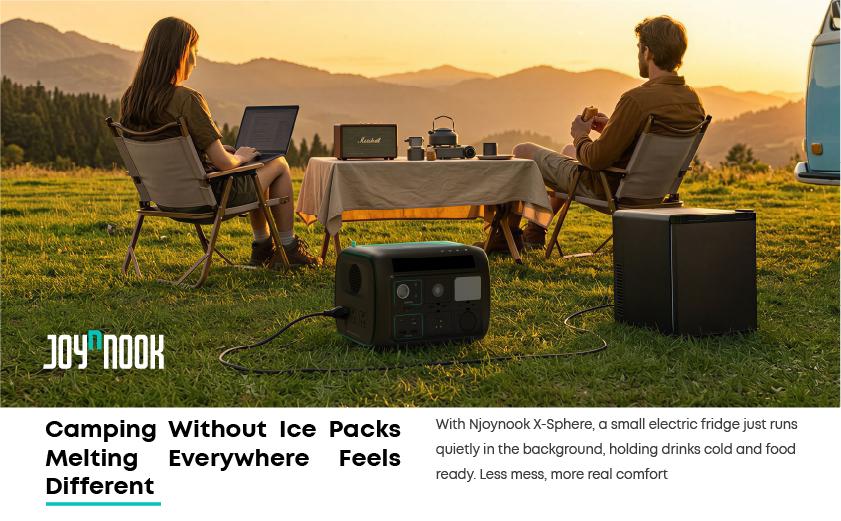
Now, this is the domain where the Njoynook system truly shines. Instead of relying on messy bags of ice that eventually turn into a puddle at the bottom of your cooler, many modern adventurers are switching to dedicated 12V portable fridges and electric coolers.
Njoynook’s modular design offers a unique advantage for the outdoor lifestyle. You can keep the main battery unit tucked away and connected to your portable power station refrigerator setup, while simultaneously using the detachable light module to see what you are grabbing for dinner.
Versatility makes Njoynook products more than just a simple battery. They will actually be the central part of your entire campsite organization.
How to Recharge Efficiently and Maximize Your Battery Life
Here are a few efficiency hacks that can significantly extend your runtime if you want to get the most out of your portable power station refrigerator setup.
- Pre-chill everything!Plug your fridge into a wall outlet at home to reach the target temperature, then switch to battery power.
- Maintain the thermal mass!A full fridge stays cold much longer than an empty one. If you don’t have enough food, add water bottles to act as a cold sink.
- Use solar trickle charging!Use solar panels during the day to trickle charge the station while it powers the fridge.
It’s good to learn how to maintain your portable power station, and it’s just as important as knowing how to use it. Regular maintenance will keep lithium cells healthy and ready for your next adventure.
Conclusion: Peace of Mind in a Box
A portable power station is a must-have tool for anyone who wants fresh food and cold drinks in situations when the traditional power grid just isn’t available, and understanding startup surges and duty cycles will help you enjoy the outdoors with total confidence.
Whether you need a small unit for a weekend getaway or a reliable backup for your home, choose the size that fits your specific fridge needs.
If you want the perfect balance between power and modular convenience, Njoynook stands ready to keep your journey (and your drinks) perfectly chilled.