
You don’t need much when you’re outside – and that’s what makes it so enjoyable. But to spend days in nature or weeks on the road, you need portable power. It’s mostly to charge your phone or have a nice drink. Maybe listen to some music while setting up a picnic or getting some work done. The problem is, not every device you want to use has the same power requirements.
So naturally, you want to know: what size portable power station do I need?
The key is understanding portable power station capacity (Wh), what devices you can run with it, and for how long. Break it down into simple steps – finding the right size will be much easier.
What “Size” Actually Means When Selecting a Portable Power Station (Watts vs Watt-Hours Explained)
You may have heard fellow nomads and nature lovers talk about the power station size, but it’s not always clear what they mean. Are they talking about power output or battery? Also, different portable power stations have different specs – for instance, Njoynook is a 512 Wh / 800 W portable power station. It’s easy to get confused. Here’s a simple explanation:
- W stands for watts and tells you how strong the power station is and what devices it can handle at once. An 800 W unit can easily power a laptop or a mini fridge.
- Whs are watt-hours. They measure battery capacity: how much energy you have and how long you can run things. With 512W, you can work on a 50W laptop for 10 hours.
When researching size, what you actually need to look for is portable power station capacity (Wh). This shows you how long your devices can run on a single charge.
Step 1 – List the Devices You Want to Power
Because you probably won’t be using a portable power station for a single device, you need to consider how much power your devices consume and how they stack up.
If you’re asking, "How many watts do I need for camping?”, here’s a common list:
- Smartphone (5-10W)
- Laptop (40-70W)
- LED lights (5-15W)
- Mini fridge (60-100W)
- Coffee maker (600-1000W)
When it comes to battery capacity needs, spending a night in the mountains is very different from living in a van or hosting a lakeside party. The more devices you need – and the more power-hungry they are – the larger your power station will need to be.
Step 2 – Estimate How Long You’ll Use Them
Now that you have a list, you also need to consider how long you’ll be using each device. This is very important, as it determines portable power station’s runtime.
Some devices run continuously, like a fridge or a Wi-Fi router. Even when the wattage is low, long usage time means big energy drain. Others, like a coffee maker or a hair dryer, are used in short bursts, so they don’t drain much energy even though they require a lot of power.
Here’s an example. A typical laptop needs 50W to run, while a coffee maker requires 1000W or more. But if you use a laptop for 8 hours, you need 400Wh – significantly less than what it takes to make a cup of coffee. To run a coffee maker for 10 minutes, you need 167Wh.
Step 3 – Match Your Needs to the Right Size
Here’s how you make sure you choose the right portable power station size.
How Much Battery Capacity Do You Actually Need?
Use this math to calculate your ideal portable power station size:
Watts (the total wattage of devices on your list) x hours (how long you plan to use them) = watt-hours
Ready to make this more complicated?
If your total usage adds up to 400-500Wh per day, you actually shouldn’t buy a 400-500Wh power station. Ideally, you should go a bit higher. Why? Things don’t always go exactly as planned. You may forget to unplug your laptop. You may need extra power for LED lights. Usage adds up faster than you’d expect, especially since energy can be lost along the way.
What Can You Run on a 300Wh, 500Wh, or 1000Wh Power Station?
Still not sure what to choose?
Here’s a portable power station size guide to help you out.
Small Power Station (300–500Wh)
Lightweight and portable, but limited in runtime, they are best for:
- Short trips
- Charging phones, tablets, and small devices
- Basic lighting
Medium Power Station (500–700Wh)
Most campers and fishermen go for the medium-sized portable power station, as well as many van lifers and mobile entrepreneurs with light setups. This is the top pick for:
- Laptops and remote work
- Weekend camping trips
- Light home backup
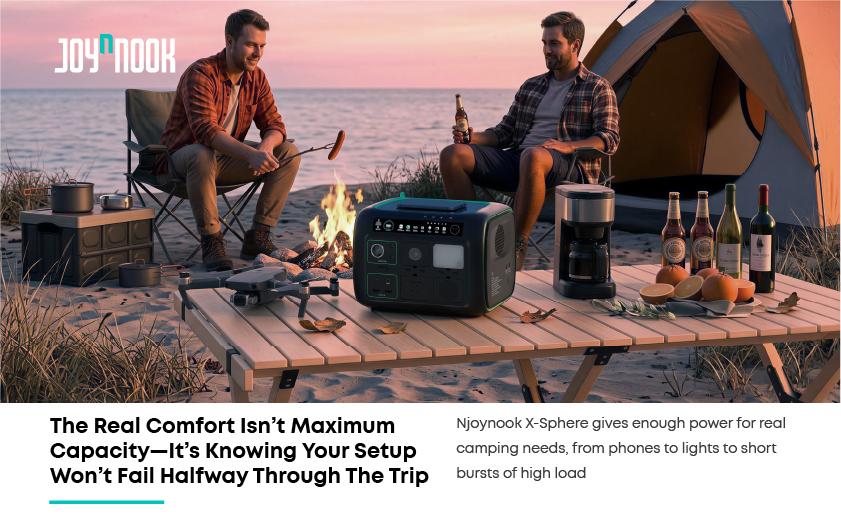
A mid-size option like a Njoynook portable power station (512Wh) fits well here. It covers all your essentials, and is the first to offer modular features like a panel light or a power bank. When fully charged, you can detach and use them separately, so instead of multiple devices, you have a single system you can just grab and go.
Large Power Station (1000Wh+)
In a 500Wh vs 1000Wh power station scenario, larger units win for:
- Van life or extended trips
- Powering multiple devices at once
- Heavier appliances
Common Mistakes When Choosing Size
What is life on the road without a bit of spontaneity?
Being short on power can ruin the experience, but you can plan ahead to avoid these mistakes:
- Underestimating usage — Inexperienced campers and road trippers often calculate for ideal conditions, but forget about unexpected situations and unplanned detours.
- Ignoring high-watt appliances – Coffee makers, kettles, and hair dryers drain the battery faster than you’d expect, even if you only use them for a few minutes.
Getting your portable power station size right means planning for both everyday use and unexpected situations. Here’s what you can do:
- Add a buffer to your calculations
- Consider peak power needs
- Think about real-life scenarios
So, What Size Portable Power Station Do You Need?
Ultimately, the question you want to ask yourself is, are you preparing for a survival trip or a relaxing stay in nature? This makes all the difference. If you’re packing light and using only what you must, like your phone, headlamp, and GPS, choose small (300-500Wh).
But if you’re in for the comfort on the move and you need continual power, a modular mid-size power station like Njoynook (512Wh) is more reliable, but just as easy to carry around.
Mid-size isn’t a bad choice for longer trips and off-grid living when you travel light and you can recharge it regularly. Anything more than that would require a larger unit (1000Wh+).
Conclusion
In the end, it comes down to how you actually plan to use it and how much flexibility you want along the way. Once you’re clear on that, it’s much easier to choose a setup that keeps you powered without turning your time outdoors into a hassle.