
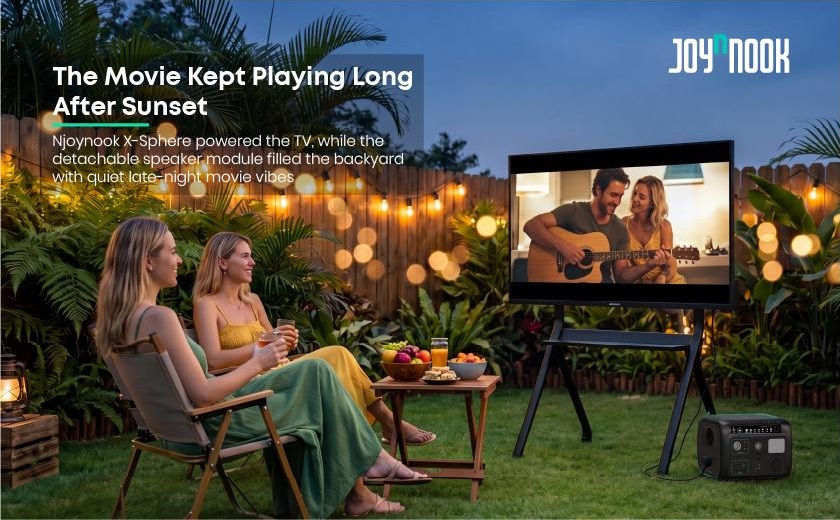
The short answer is yes! You could be planning an epic backyard movie night, setting up a tailgate for the big game, or looking for a way to stay informed during a home power outage – a portable power station could absolutely run your modern television without a wall outlet.
However, the real question isn't if it can run, but for how long.
Running out of battery in a critical moment would ruin your fun, but we won’t let that happen. Here’s how your TV’s wattage relates to your power station’s capacity.
Understanding Watts TV Usage: How Much Power Does Your Screen Need?
Before you plug in, you need to know how power-hungry your device is. Modern screens have become more energy-efficient, but that still depends on size and display technology.
Size Matters (and Technology Does Too)
A 32-inch LED TV in a bedroom uses a fraction of the power required by a 75-inch theater-style screen. Furthermore, the technology behind the glass – LED, OLED, or QLED – plays a major role. OLED screens, for example, often draw more power because each individual pixel is self-lit, whereas standard LED screens use a more efficient (though less vibrant) backlight system.
|
TV Type & Size |
Average Wattage (W) |
Typical Use Case |
|
32” LED TV |
30W – 50W |
Small campers / Bedroom |
|
43” LED TV |
50W – 70W |
Van-life / Digital Nomads |
|
55” LED TV |
60W – 100W |
Standard Backyard Movie Night |
|
65”+ LED TV |
100W – 150W |
Large Living Rooms |
|
55” – 65” OLED |
110W – 160W |
High-End Outdoor Cinema |
How to Calculate Run Time (The 85% Rule)
To avoid a mid-movie blackout, you need to calculate your expected run time. You cannot simply divide the battery capacity by the TV's wattage. Why? Because power stations and TVs use different types of electricity, and because of something called “inverter efficiency”.
You don’t have to understand the difference between DC (Direct Current) and AC (Alternating Current) to know that you need a power adapter or an inverter to use them together. A portable power station, which stores energy in DC, converts electricity using a built-in inverter when you plug in your TV, which runs on AC. The problem is – this process creates heat, which leads to a loss of about 15% of usable energy. To get an accurate estimate, we use the 85% rule:
(Capacity in Wh x 0.85) / Device Wattage = Total Run Time (Hours)
The Calculation in Action: Njoynook Alpha 800
Let’s look at a practical example using the Njoynook 800 Portable Power Station, which has a capacity of 512Wh. If you are running a standard 50-inch LED TV that pulls roughly 60W, the math looks like this:
(512Wh x 0.85) / 60W = 7.25 Hours
Why a Pure Sine Wave Inverter is Non-Negotiable
A TV is a sensitive piece of electronic equipment. Inside that slim frame are complex circuit boards and processors that require clean electricity.
Cheaper power units often use "Modified Sine Wave" inverters, which deliver power in blocky, jagged waves. If you’ve ever noticed annoying flickering on the screen or hums in the speakers, that’s probably the reason. A cheap inverter can even cause permanent damage to the TV’s power supply.
All reliable power stations, including Njoynook, are equipped with a Pure Sine Wave inverter, which mimics the smooth, consistent flow of the power coming out of your home’s wall outlets. This ensures that your off-grid entertainment is indistinguishable from your living room experience – no noise, no flicker, and even more important, no risk to your electronics.
Beyond the Campsite: Home Emergency Backup
While outdoor movie nights are the fun side of portable power, there is a vital practical side: off-grid safety.
For those living in remote areas, telesion is often the most reliable source of local news and weather alerts. But during storms or grid failures, when most rely on gas generators, a TV can let you down. Traditional generators are loud and must remain outdoors, but a portable power station is silent and emission-free. It can live in your living room and keep your peace of mind – and your family informed and calm without the hassle of fuel or noise.
A mid-sized unit like the Njoynook 800 can keep a 43-inch TV running for nearly 8 hours, giving you a critical window of communication during an outage.
Top Tips for Maximizing TV Run Time Off-Grid
If you want to squeeze every possible minute out of your battery, follow these efficiency hacks:
- Lower the Brightness:Backlighting is the biggest energy drain. Dropping the brightness from 100% to 70% can significantly reduce wattage draw.
- Skip the Soundbar: High-end soundbars can pull 50W or more on their own. For maximum runtime, use the TV’s built-in speakers.
- Disable Smart Features:If you aren't streaming (e.g., you're using a DVD player or an HDMI cable), turn off the TV’s Wi-Fi and Bluetooth searching to save a few extra watts.
- Use Solar During the Day:If you’re tailgating, pair your station with essential camping accessories like a 100W solar panel. On a sunny day, the solar input can often match the TV's draw, meaning you aren't draining the battery at all.
Conclusion: Is It Worth It?
Running a TV on a portable power station is not (only) a glamping novelty reserved for modern digital nomads. It’s a practical solution that gives you freedom and mobility, but doesn’t ask you to compromise your comfort or stability in an emergency – without the bulk of a traditional generator.
The Verdict: If you value clean power, silent operation, and the flexibility to watch what you want, where you want, it is absolutely worth it.
Pro-Tip: Check the sticker on the back of your TV (usually near the power cord). Look for the "W" or "Wattage" rating. Once you have that number, you can match it with a Njoynook unit to build the perfect off-grid entertainment hub.