
There is no feeling quite like waking up in the wilderness, unzipping your tent to a crisp mountain sunrise, and realizing you don't have to settle for lukewarm instant grounds.
The dream of a "real" cup of coffee off-grid is the ultimate outdoor luxury, but it’s often the first thing campers give up. Why? Because coffee makers are notorious energy hogs.
If you’ve ever wondered if your portable power station can handle your morning brew, the answer is a resounding yes – but only if you understand the math behind your machine.
The Science of Heat: Why Coffee Machines Need So Much Power
Heating water from "mountain stream cold" to "brewing hot" in under sixty seconds requires a massive, concentrated burst of energy.
Understanding Watts Coffee Machine Requirements
Most appliances we use outdoors, like LED lights or even mini-fridges, are "marathon runners" – they sip a small amount of power over a long period. A coffee maker, however, is a "sprinter." Inside that machine is a high-resistance heating element designed to flash-boil water. This process requires a significant amount of Watts (W), which measures the "pull" or strength of the electricity needed at any given moment.
It’s also important to distinguish between brewing wattage and standby wattage. While your machine might only use 5W to keep its digital clock running, the moment you hit "Brew," that requirement can jump to 1,200W or more. If your power station’s inverter isn't rated to handle that peak, the system will simply shut down to protect itself.
Continuous Power vs. Surge Power
Many modern coffee makers, especially those with internal pumps or grinders, require a surge of power to kickstart the motor. A machine labeled as 600W might actually demand 1,000W for a split second when it first engages. This is where high-quality inverters matter. Modern pod machines also contain sensitive circuit boards that require pure-sine-wave inverters – the kind found in premium units like Njoynook – to ensure the electronics don't fry or glitch during the brewing cycle.
Power Profiles: Common Coffee Makers and Their Draw
Not all coffee makers are created equal. To build the right setup, you first need to know which category your caffeine habit falls into.
Standard Drip Coffee Makers (800W – 1200W)
These are the most common household machines. They represent the "middle ground" for portable power. A standard 4-cup or 5-cup drip machine typically pulls around 800W to 900W. While they take a few minutes to brew, they are relatively predictable and work well with medium-sized power stations that have a high enough continuous output.
Pod Machines (Nespresso/Keurig) (1200W – 1500W)
Pod machines are the high-speed challenge of the camping world. They prioritize speed, which means they need to heat water almost instantly. This rapid heating requires a massive draw, often exceeding 1300W. To run a Keurig or Nespresso, you typically need a "pro-level" power station with a high inverter rating, as these will easily trip the safety breakers on smaller, budget-friendly units.
Espresso Machines and Milk Frothers (1500W+)
These are the heavy hitters of the kitchen. Between the high-pressure pumps and the steam boilers, espresso machines usually stay firmly in the home kitchen. Running one off-grid usually requires a massive 2000W+ unit, which often weighs 50lbs or more – hardly "portable" if you’re trying to keep your van or campsite lean.
Travel-Sized and 12V DC Coffee Makers (200W – 600W)
These are the efficiency kings. Designed specifically for truckers and campers, these machines take longer to brew but pull significantly less power. A 600W travel drip machine is the "sweet spot," providing a hot pot of coffee without exhausting your battery reserves in one go.
Choosing the Right Portable Power Station Coffee Maker Setup
The secret to a successful outdoor coffee station isn't just about how much battery you have; it’s about how much power the station can "push" at once.
The Inverter is Key (Output vs. Capacity)
As we’ve discussed in previous guides, Watt-hours (Wh) tell you how long your gear will run, but Watts (W) tell you if it will run at all. If you have a 1000Wh battery but only a 300W inverter, you can’t run a coffee maker – period.
This is where the Njoynook power station stands out. With 800W of continuous power and a 1600W surge capability, it is specifically designed to handle the "sprinter" nature of coffee machines. It occupies the perfect middle ground: it has the "muscle" to handle travel-sized drip machines and high-efficiency brewers, but it lacks the cumbersome bulk and weight of 50lb industrial units.
Calculating Cups Per Charge
Want to know how many pots you can brew? Use this quick math guide. A 600W machine running for a 10-minute brew cycle consumes about 100Wh of energy. On a 512Wh station like the Njoynook 512Wh / 800W, you could theoretically brew 4 to 5 full pots of coffee before needing a recharge. Since most people only need one or two pots a morning, this leaves plenty of "juice" left for your laptop, lights, and phones.
Practical Tips for Off-Grid Brewing
Managing your power is as much about strategy as it is about hardware. Here is how to keep your caffeine fix from draining your station.
Pre-Heating with Solar or DC
If you have a modular setup with solar panels, use that "free" energy during the day to pre-heat water in a simple kettle if you're using manual methods, or simply brew during peak sun hours when the solar input can offset the battery drain.
The Thermal Carafe Hack
One of the biggest energy wastes in coffee making is the "stay-warm" hot plate. These plates continue to pull power long after the coffee is brewed. Choosing a machine with an insulated thermal carafe allows you to brew once, turn the machine off immediately, and keep your coffee hot for hours using zero additional battery.
Using Modular Accessories
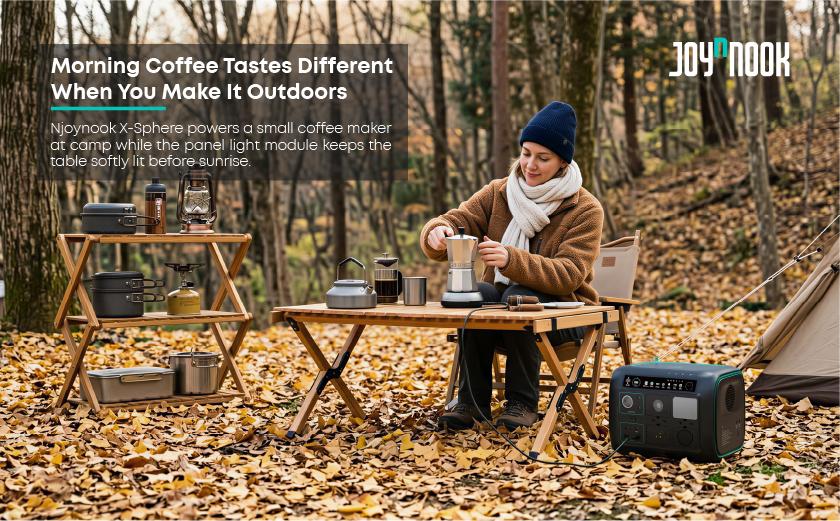
A great coffee station needs more than just power; it needs organization. This is where a modular system shines. Use the Njoynook’s detachable magnetic power bank to keep your phone charged on the table, or use the detachable lights to illuminate your brewing area. This ensures you aren't draining the main unit’s "brewing reserves" on small tasks like lighting or charging gadgets, keeping every possible watt-hour dedicated to that first morning cup.
Top 3 Solutions for Portable Coffee
The Minimalist (AeroPress + Portable Kettle)
- An AeroPress combined with a small portable electric kettle.
- High quality, low power draw, and very compact.
The Balanced Setup (Njoynook 800W + 600W Travel Drip)
- This is the ultimate "no-fuss" setup for most campers.
The Luxury Setup (Large 2000W Unit + Home Espresso Machine)
- A large 2000W station paired with a home Nespresso machine.
- Perfect for glamping, where weight isn't an issue.
Conclusion
Brewing coffee in the wild is all about the 800W rule: if your station can handle that threshold, the wilderness is your cafe. By matching your caffeine habits to a capable, modular unit like the Njoynook Alpha 800, you can enjoy the comforts of home without the clutter of a heavy generator. Pack smart, brew hot, and enjoy the view.