
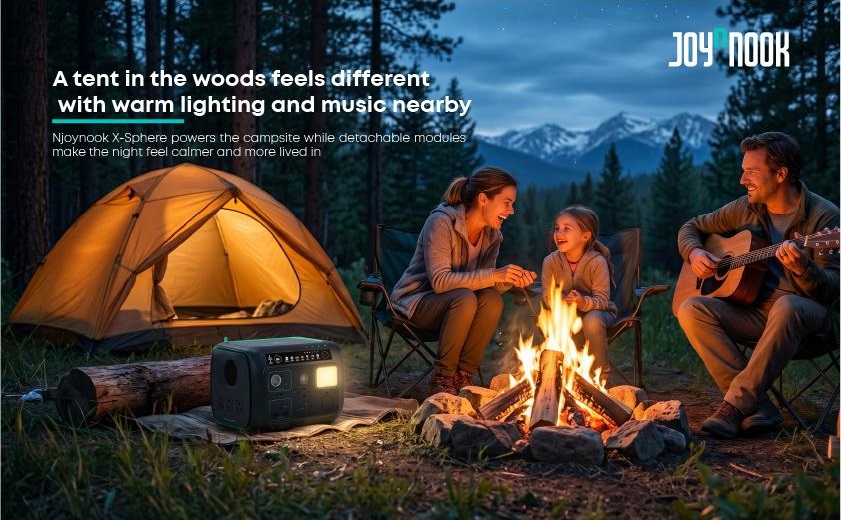
The way we power our outdoor adventures has undergone a massive evolution. Not long ago, "portable power" meant a handful of AA batteries for a plastic lantern; today, we are bringing full off-grid kitchens, high-performance laptops, and cinema-grade projectors into the backcountry. As our energy needs have grown, so has the equipment – now, your vehicle is more battery than legroom.
This is where the modular portable power station entirely changes the game.
Unlike traditional all-in-one units that are heavy, fixed, and rigid, a modular system is a single unit that replaces multiple separate devices while providing flexibility and peace of mind. It solves the classic weight vs. power dilemma by allowing you to customize your setup for the specific trip at hand.
The Njoynook 5-in-1 modular power station is the prime example of this next-gen philosophy. It isn’t just about adding extra battery capacity; it is about the ability to recharge and detach your favorite tools – like your lighting or a power bank – exactly when and where you need them.
The Core Mechanics of a Modular Portable Power Station
A modular power station is designed to be more than just a battery with an AC outlet; it acts as a complete, all-in-one power supply with detachable components.
Scalable Capacity with Expansion Batteries
The architecture of a modular system typically consists of a base unit and optional expansion batteries. Put simply, it gives you more Watt-hours (Wh) in a single portable power unit than traditional setups, so that you don’t have to buy a larger system for longer trips or power-heavy outings.
While competitors like EcoFlow often focus purely on increasing raw capacity, Njoynook differentiates itself by focusing on functional modules. For instance, the Njoynook system utilizes a magnetic charging design that keeps functional accessories, such as Bluetooth speakers and LED panel lights, topped up while they are docked to the main unit.
This means your accessories are always charged and ready to be used as independent devices.
Plug-and-Play Functionality
Modularity is only useful if it is simple. The last thing you’d want is more cables, so you should be able to easily snap on modules into docking ports and hear a satisfying “click”. Behind the scenes, an integrated Battery Management System (BMS) monitors the stack to make sure it’s working safely and efficiently.
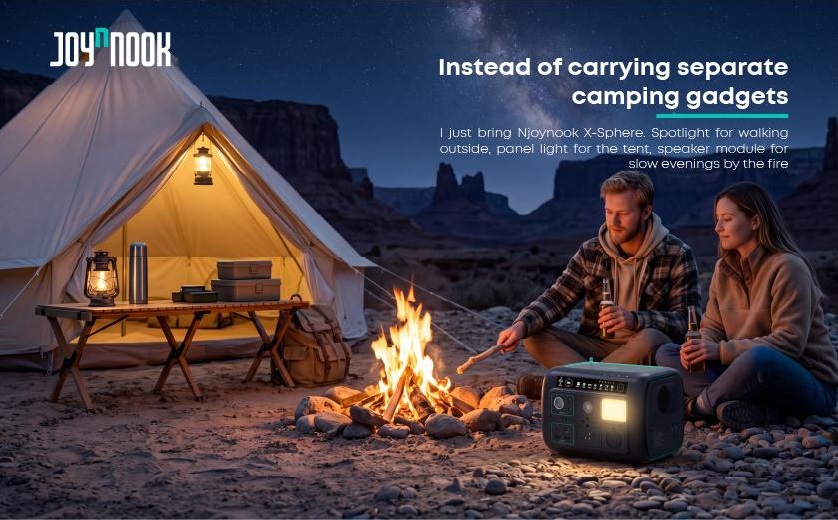
Njonook Apha 800 is the only power station with this simple plug-and-play functionality. Every module – spot light, panel light, Bluetooth speaker, and a portable power bank – snaps on and off the central hub effortlessly. Next time, you can let your kids do it; it’s as simple (and fun) as building Legos.
How Modularity Streamlines Your Outdoor Power Setup
Too often, managing an outdoor power setup feels like a chore – especially when there are multiple charges, bulky batteries, or separate lights involved.
Generator Weight Management: Take Only What You Need
One of the greatest advantages of modularity is fractional transport. Instead of struggling with a single 70lb industrial unit, you can move a 40lb base and a 30lb expansion battery separately. Furthermore, you can tailor your weight to the trip: bring one battery for a quick weekend getaway, or stack three for a week-long off-grid expedition.
The Njoynook 512 Wh / 800W is particularly impressive here, weighing in at just 15.5 lbs. And the best thing about it is that you don’t have to pack separate lanterns and speakers or search for small power banks at the eleventh hour. Having lighting and audio components already integrated and detachable will make your packing list much simpler.
Space Optimization in Vehicles and Tents
In the tight confines of a van or a tent, space is a premium resource. Modular designs allow for a smaller footprint because you can tuck expansion batteries into awkward storage spaces while keeping the main base unit accessible for plugging in devices.
This way, you eliminate the need for multiple power charges and create space for what really matters – people, pets, and pure relaxation.
Enhancing Versatility Across Different Scenarios
This weekend, you may decide to work from a park or camp in the desert. A modular system gives you the freedom to unplug and hit the road.
Minimalist Off-Grid Camping and Day Trips
For quick outings, you can leave the modules you don’t need at home and use the base unit alone. It carries enough power to charge phones, drones, and handle light laptop work.
Extended Off-Grid Overlanding
When you’re off the grid for 3+ days, you can stack modules to support high-draw appliances like portable fridges, electric coolers, and even induction cooktops.
Emergency Backup and Basecamp Stability
In a basecamp or home backup scenario, modularity allows for "hot-swapping" batteries. You can remove an empty battery to charge it via solar while the main unit continues to provide uninterrupted power to critical devices like a CPAP machine or a Wi-Fi router.
Maximizing Efficiency and Longevity
A modular power station is a long-term investment in your outdoor lifestyle.
Faster Recharging for Complex Setups
Many modular systems support parallel charging, so that you can charge the base unit and modules at the same time. Plus, you can use a combination of solar panels and AC power and cut down the time you spend waiting for a full tank.
Future-Proofing Your Investment
A modular setup also lasts longer. With a traditional power station, if the battery degrades, you can wave goodbye to the entire unit (including the expensive inverter and ports). A modular system is more practical because you don’t have to buy a new unit when the old one breaks. You can simply replace or upgrade individual battery models.
Key Considerations Before Going Modular
A few things you should consider before you decide to go fully modular:
Compatibility and Brand Ecosystems
Modularity usually means committing to a specific brand. Mixing and matching modules from different manufacturers rarely works. At best, you can expect communication problems that ruin the experience. At worst, you risk permanently damaging your gear.
Total Power Output (W) vs. Capacity (Wh)
Another thing to remember is that Watts (W) and Watt-hours (Wh) are not the same:
- Watts (W): The output strength. This determines what you can run.
- Watt-hours (Wh): The battery capacity. This determines how long you can run it.
Adding extra battery modules increases your Wh (runtime), but it does not change the base unit’s inverter rating (W). The Njoynook 800’s specs – 800W continuous and 1600W surge – serve as the benchmark for versatility. This is the "sweet spot" that allows you to run high-draw appliances like a portable coffee maker or blender without the burden of a massive, non-portable 2000W unit.
Conclusion
True outdoor enthusiasts know that portable power means little without simplicity. By moving toward a "build-your-own" energy model, you gain the freedom to take exactly the power you need and nothing you don't. Whether you are a minimalist camper or a dedicated van-lifer, a modular setup ensures that your time outdoors is defined by the experience, not the equipment.